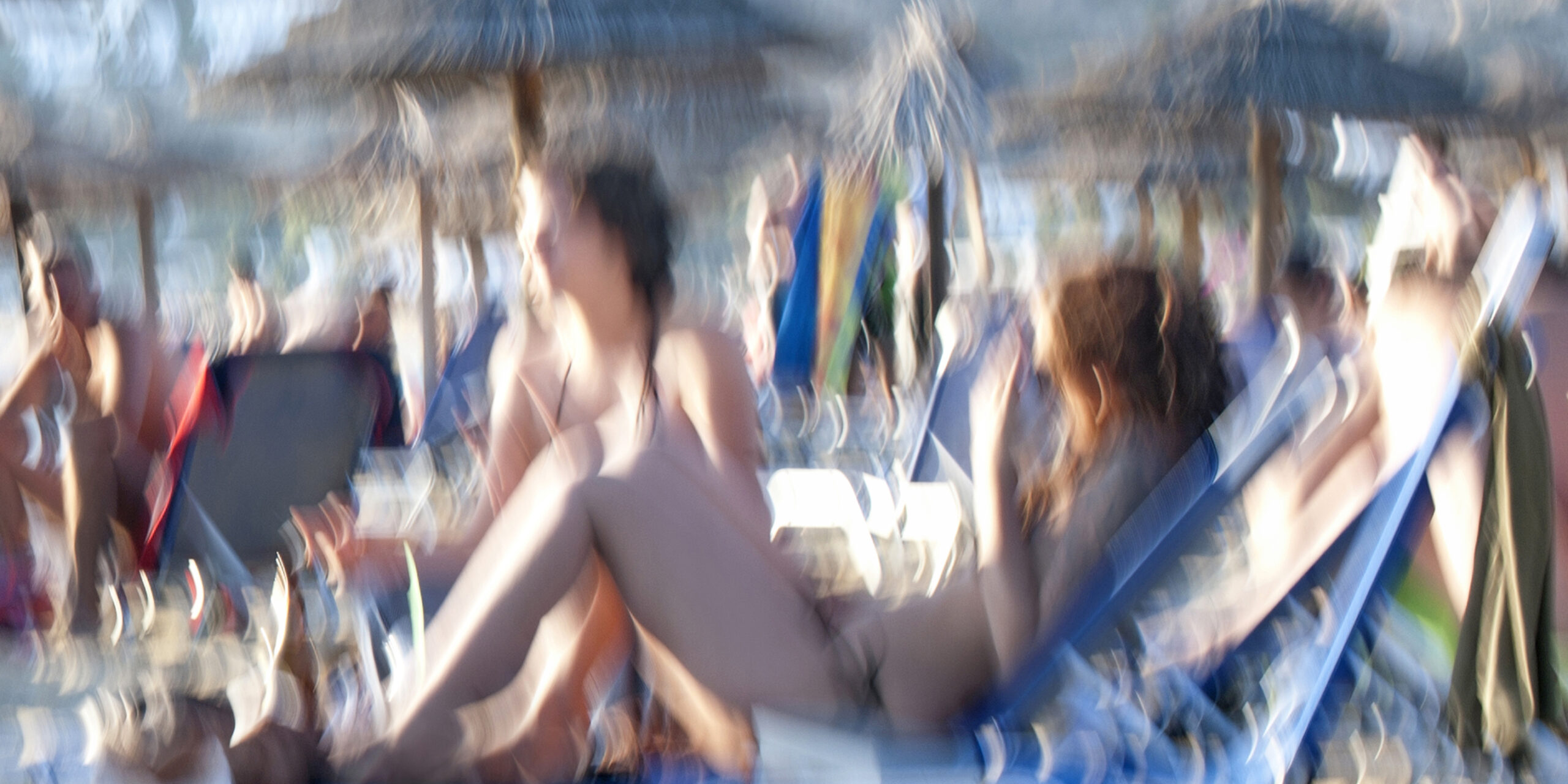
The way Vittis employs photographic media and light recalls the work of Nikos Kessanlis in Phantasmagories of Identity (Φαντασμαγορίες της Ταυτότητας, 1965), a series in which the artist experimented with the distortion of the object on fabrics.
“If one considers that this light is nothing more than a white brushstroke… I discovered that I was able to draw with light.” i
With a similar approach, Vittis uses the essence of the photographic medium—light itself—creating his works with extremely slow shutter speeds, without any digital processing or use of artificial intelligence. To Walter Benjamin’s anxiety regarding the lost aura of the artwork due to its endless reproducibility, Vittis responds with his own personal technical approach to the artistic process, and with Marcel Duchamp’s idea that the aura now depends upon and is determined by the viewer.
The blurred, almost painterly frames that emerge in certain works of the exhibition directly evoke the chromatic tonalities of the Impressionists. The familiar, relaxed images of half-naked bathers on the beach amid the summer lethargy of the present wink at distant picnics in parks and forests of the past, where nature and light held leading roles alongside scenes of everyday life. The bold brushstrokes of the Impressionists, the bright vivid colors, and the focus not on the “completed work” but rather on the impression produced in the viewer find an analogy in the works of the exhibition, where sensation becomes experience and the body becomes energy.
The course of this transition traced by the artist gives rise to works-as-processes, works in which action is captured and intensity recorded. This approach echoes Francis Bacon’s practice in the Heads series (1947–1949).
The decomposition of the image through intensity, the distortion of the human form during transformation, and matter turning into energy are also present in Vittis’s works, yet his approach differs. Where Bacon depicts anxiety and existential terror, Vittis’s figures resemble liberated entities, some in a meditative state. His figures within the water and upon the sand penetrate space, challenge the boundaries between nature and humanity, and capture a movement that is never meant to conclude. Through the artist’s practice, ghosts of light and color are composed, balancing between existence and transformation, trace and the negotiation of identity. Dance-like forms articulate their own inner rhythm, where “rhythm is the answer of the environment to chaos.” (Deleuze & Guattari 1987, 313). ii
Here, the artist’s work becomes a visual essay on the philosophy of Gilles Deleuze and the continuous process of transformation that characterizes everything, as argued in his work with Félix Guattari, A Thousand Plateaus. iii
Beginning from Deterritorialization, a process through which a subject escapes its predefined forms (social identities and roles) and follows a “line of flight,” Vittis’s photographic practice—with images lacking boundaries and clear depiction—allows light itself to serve this very escape from stable structures. This slow overexposure, the dynamic and creative process through which light consumes form and erodes contours, permitting the subject to escape its identity and become flow and energy, depicts liberation from form itself. In this way, Vittis captures Deleuze’s “becoming” at the exact moment it occurs, before it solidifies into a specific form. The body disperses into space and environment, becoming one with them, while the images of the exhibition convey the dynamics of this transformation, capturing both the relationship between elements and the tension within the space between them, transforming it into sensation for the viewer.
The point at which it is no longer possible to distinguish where the body begins and where the beach ends—where water and form become an inseparable whole—is a pure Zone of Indiscernibility, a state in which characteristics and properties are no longer distinct, and what matters most is the intermediate space. In this in-between space, photography does not capture subjects, landscape, or light, but rather what unfolds between them, focusing on the relationship between forces rather than on the object itself, on becoming rather than on destination.
And if the replacement of the geometry of bodies with this osmosis, this flow of intensity that abolishes borders and ontological identities is not enough, Vittis in the exhibition
Beach. One Day. Becoming – Light also raises questions concerning the linearity of time itself.
The camera click, which normally freezes the “now,” the “before” and “after”—the defining characteristic of photography that captures the moment and transforms it into memory, Chronos, according to Deleuze—in Vittis’s works becomes duration, a condition. It is the time of becoming, of Aion. There, present, past, and future coexist simultaneously. In the same way, form does not simply “exist” as static being, but rather “happens” as osmosis, already containing within itself a fragment of the future.
During long exposure, time is layered upon the film. The past (the beginning of the shot) and the present (its conclusion) coexist within the same image. If identity depends upon the memory of “who I was a second ago,” overexposure abolishes it. The blinding light of overexposure imposes an osmosis between subject and environment, transforming the beach into a landscape of becoming. The subject never has the chance simply to “be” something, because it remains in continuous osmosis with the light that transforms it and the surrounding environment.
Time ceases to function as a line dividing before from after, and the title of the exhibition, while beginning with an apparently simple promise (a beach, one day—a place, a span of twenty-four hours), is deconstructed. Initially, the artist invites the viewer to recall personal memories and familiar images of relaxation and release, to retrieve the sensory memory of sunlight upon the skin on a summer day, and gradually leads them into a state where the “self,” social identity itself, dissolves and disappears. It is a place where subject and environment—the daylight—are no longer separate, and the beach becomes a liminal space in which the viewer experiences the dissolution of boundaries.
The artist does not fear the social implications of his work. He articulates them clearly and without evasion. In an era in which the image possesses power beyond its creators, and is used to categorize, define, and ultimately evaluate, Vittis consciously chooses ambiguity. The overexposure employed in the creation of his works does not function as a technical “mistake,” but as a strategy of resistance against hierarchical structures, as a choice of stripping away characteristics in search of essence, as an aesthetic dematerialization in favor of capturing energy. Gender, age, and physical characteristics become indistinct, liberating the image from the data that drive labeling, quick judgments, and easy conclusions. Instead, his figures reward pause, observation, and questioning.
The viewer is invited to provide answers not only to the questions posed by the works, but also to those raised within themselves during the act of viewing. Their experiences provide the ground upon which the artist’s figures claim their space and place without ever fully occupying them.
The existential Odyssey of Vittis’s figures has no Ithaca, and this is a deliberate artistic choice.
Delia Potamianou
_________
i “Nikos Kessanlis – The Return of the Barbarian,” interview with Emily Tsigkou, The Art Magazine, Issue 19, September–October 1995, pp. 40–46.
ii “Rhythm is the milieus’ answer to chaos. What chaos and rhythm have in common is the in-between—between two milieus, rhythm-chaos or the chaosmos.”
iii Deleuze, Gilles, and Félix Guattari. 1987. A Thousand Plateaus: Capitalism and Schizophrenia. Translated by Brian Massumi. Minneapolis: University of Minnesota Press.